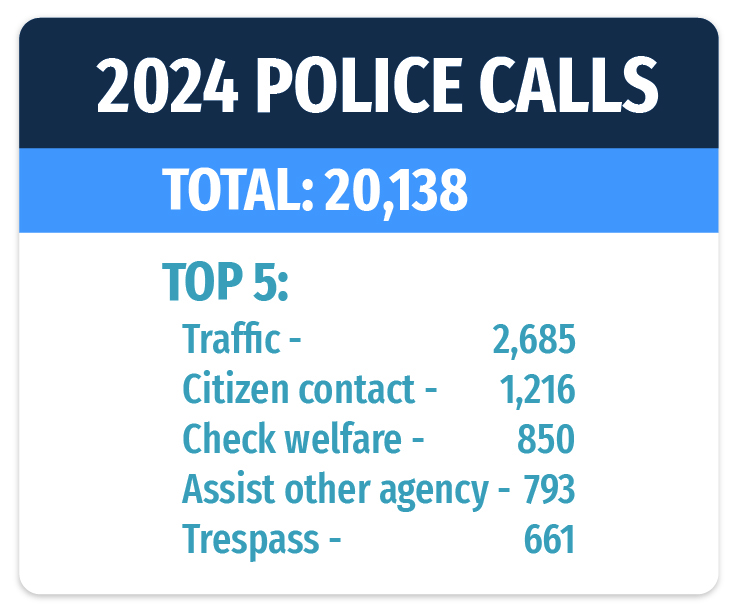
During 2024, Keizer police handled an average of 55 calls a day for some kind of help.
The needs varied.
Officers handled everything from assaults to shoplifting to trespassing. They responded to traffic issues or to check that someone was OK. They helped other police agencies nearly 800 times over the year – roughly 70 instances a month.
In all, the Keizer Police Department logged 20,138 “calls for service,” according to an agency report released to Keizertimes. A “call for service” is when a police officer is dispatched to a report or initiates a police action, such as a traffic stop.
Now, the city Police Fee Task Force is probing deep to determine how police use their time, how Keizer’s force compares to other cities, and what might be needed for more city funding.
The task force last month received the police agency’s preliminary staffing report. At a meeting scheduled for Wednesday, Nov. 19, the task force is to get a critical addition – details on crime in the city.
“We want to look for trends and where we are spending time,” said Councilor Shaney Starr.
She chairs the task force that includes Councilors Kyle Juran and Dan Kohler.
The Keizer City Council is likely to again consider raising the monthly police service fee but that would only help pay for current operations at the $10 million police department. An increase from $6.90 to $7.76 a month is under consideration, possibly to take effect in January. City officials estimate the increase would produce an extra $90,000.
But the task force is looking beyond that to assess what kind of police department the community needs – and wants. That is a prelude to a possible public vote on more significant police funding. Community meetings of some sort are expected along the way.
The preliminary report outlined in detail how the Keizer Police Department operates, including detailed descriptions of every job, costs for employees and new patrol cars, and what other communities have.
“This report demonstrates both the dedication of our officers and the structural challenges that must be addressed to maintain the safety and trust of the Keizer community,” the 39-page report concluded.
The report said that the Keizer agency “operates below regional staffing averages” and expanding the staff is “recommended to meet service demands and reduce dependence on overtime and mutual aid.”
To do that, the agency report said, Keizer would need to boost its police staffing by 20% – from the equivalent of 42 full-time employees to 51. The agency’s average cost per employee, according to the report, is $230,912 a year. That means the city would need an additional $2 million to fund such an expansion.
But in a more recent interview, Police Chief Andrew Copeland said he’s not advocating such an expansion.
“That’s not my goal from this,” he said. “I hope to remain funded with the amount of people we have currently.”
He said his “wish list” for the future would be to add two patrol officers to the 22 now budgeted, plus one detective and one support worker.
Such an expansion “would be a service to the community. It would just mean more cases are going to be worked thoroughly for the citizens of Keizer.”
The preliminary report compared Keizer’s staffing costs to other agencies, concluding the city spends about $25,000 a year less in pay and benefits for each employee compared to other Oregon cities.
The report also compared staffing ratios, concluding that Keizer’s ratio of 1.06 per 1,000 residents is below the average of 1.27 at other cities ranging from Redmond to Grants Pass.
The Keizer agency “maintains one of the lowest officer-to-population ratios in the state, despite comparable community size,” the report said. “This disparity affects response times, officer workload and limits proactive enforcement.”
But such a measure is generally rejected by some police organizations.
“Ready-made, universally applicable patrol staffing standards do not exist. Ratios, such as officers-per-thousand population, are totally inappropriate as a basis for staffing decisions,” according to the International Association of Chiefs of Police.
In the interview, Copeland said he agreed, but his staff provided the statistics to satisfy a request from the task force.
“We want our community to be safe with the appropriate number of officers for the number of incidents,” Copeland said.
Federal statistics indicate Keizer’s rate of violent and property crime is well below the national average.
Copeland said overall he believes Keizer is a safe community even after recent high-profile shootings. He has lived in the community about 40 years.
“I want my wife to be able to leave my house and drive to the store at any time it’s open,” he said. “I want my 16-year-old daughter to drive anywhere in the city and I don’t have to worry about her being safe.”
He said that “knowing everything that I know, I feel that my family is safe.”
PREVIOUS COVERAGE:
Task force seeks data on Keizer policing as funding considered
Keizer task force convenes Thursday to work on police funding
City officials raise alarm about growing costs, money needs
NEWS TIP? Send your suggestion or tip to [email protected].
SUBSCRIBE: Get around-the-clock access to news about Keizer with a digital subscription to the Keizertimes. It’s secure, is available at $10 a month, and takes just a moment when you go HERE. Your support for local journalism is vital.