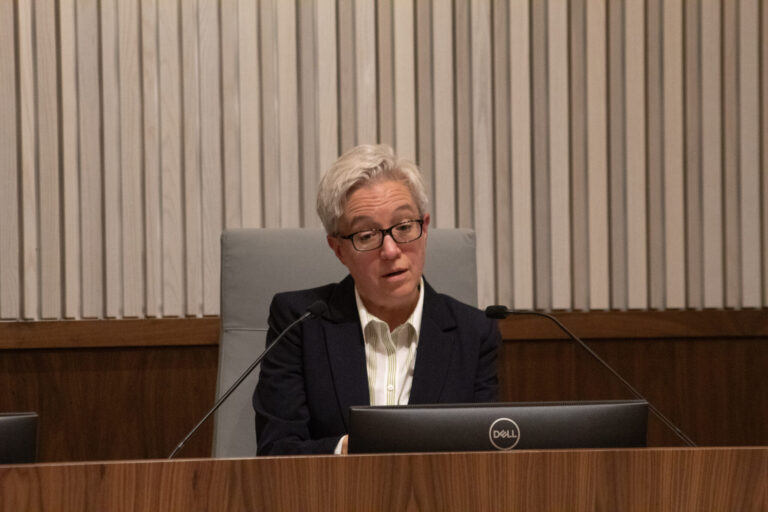
Dozens of business leaders packed into a room Thursday morning to question Cherriots leaders about their proposed tax on businesses.
The forum was a chance for Salem’s mass transit agency to present information on the tax and for business owners to voice their thoughts.
The Salem Area Mass Transit District, known as Cherriots, is proposing to tax Salem and Keizer businesses starting in January, using authority provided by legislators through a 2018 state law. The tax wouldn’t need voter consent.
If approved by the Cherriots board, companies in the area’s urban growth boundary would be taxed seven tenths of a percent, or 0.007, of their payroll. The transit district could propose up to 0.008 before finally settling on a rate.
At the proposed rate, a company with $500,000 payroll would be taxed $3,500.
The board is expected to vote on imposing the tax sometime this fall.
The tax revenue, estimated to raise $39 million in the first year, would be spent increasing service frequency, buying more buses and longer term projects like new transit centers, the agency has said.
Maria Hinojos Pressey, Cherriots board president, said Thursday that for local residents, the frequency of bus runs can make “the difference between being able to keep your job and keep a roof over your head or obviously not.”
“Missing a bus that runs only once an hour is absolutely detrimental to many members of our community,” she said.
Thursday’s forum was hosted by the Salem Area Chamber of Commerce at the chamber offices north of downtown. Only members of the Salem and Keizer chambers could attend.
Cherriots General Manager Allan Pollock presented a slideshow about the transit agency’s standing compared to mass transit districts in Portland and Eugene along with details about the new tax.
Cherriots’ service is excellent, he said, but the frequency it’s provided at is not and the tax will improve it.
A long and tense Q-and-A session followed his presentation, where business owners expressed concern and doubt. Most who shared questions or comments voiced opposition to the tax while only a couple said they supported it.
One business owner asked how to make the tax appealing to his employees, when it will take money from the business.
“I need to sell this, because it’s going to make decisions that will impact my team and my employees, our ability to do things for them. So ‘it’s going to pay off, it’s going to work out,’ is not an answer that my team’s going to take,” he said.
Many business owners felt they were being forced to pay into a service they, along with their employees and customers, don’t use. Others voiced concern over some businesses not being fully recovered from the economic impacts of the Covid pandemic.
“My question is, what local and regional economic data did you look at, have you evaluated that said, now is the time business the business community is thriving, now is the time for us to voice any tax on business?” Mike Herron of VIP’s Industries said. “What economic data, what economic studies on our side of the equation have you been looking at?”
While people asked questions, others shook their heads, laughed or scoffed at board member responses and complained that questions weren’t fully answered.
TJ Sullivan, president of the Salem Main Street Association, brought up then-state Sen. Peter Courtney’s work on the bill which authorized Cherriots to start the tax. He said Cherriots and business leaders agreed at the time not to implement the tax unless the transit agency lost state funding.
“I was in a room with Peter Courtney in 2017 and had to listen to him scream and swear and yell at us over this and he would be rolling in his grave if he knew that this was happening,” Sullivan said Thursday.
Courtney worked with Cherriots and business leaders after the same payroll tax proposal went to voters in 2015 and failed.
Nothing in the laws requires Cherriots to start the tax only after losing other funding.
The 2018 legislation also switched Cherriots from an elected board to one appointed by the governor.
One point Cherriots leaders mentioned several times during the forum was how the tax would address riders’ wants and needs for bus service.
Through regular surveys, Cherriots found that riders want more frequency in services and routes that connect underserved areas, like southeast Salem. Although riders want some improvements, they are more satisfied with Cherriots than the national average for transit agencies, according to data presented Thursday.
“I believe Cherriots does an excellent job, but with increased investment that Cherriots can be a bigger catalyst to improve community livability, not only for the residents, but for its business community,” Pollock told Salem Reporter this week.
Cherriots will be at community events throughout August to talk with people about the tax, and will host organized meetings on it starting in September.
The board is expected to vote on imposing the tax sometime this fall.